Status: On Vacation; sick with bronchitis--may have to extend my time off further to get over this
Doing: Writing this blog; surfing the net; answering e-mails
Watching: "Pitch Black"; CBS Evening News
Listening to: Nothing at the moment.
Reading: Kushiel's Scion by Jacqueline Carey (Page 173)
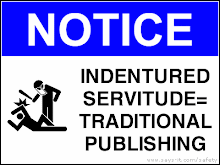
TOPIC: WHAT GOOD IS A TRADITIONAL PUBLISHER?
Something that I've been trying to get my points across for the last few years: That traditional publishing isn't as cracked up as it looks. And while the author of this article still vouches for mainstream; I am still strongly advocating that you always keep your options open.
A colleague recently put this question in the bluntest of terms: "If publishers won't promote your book and they take a huge percentage, what exactly do they do for the author?"
I wouldn't say that publishing houses won't promote your book, but first-time authors get a very small piece of the marketing pie-and publishers have smaller marketing budgets than they used to.
They have smaller everything budgets than they used to, which means less personal attention, and that's one reason someone could legitimately ask: "Well, what good are they, then?"
Another reason is the increasing availability of print-on-demand technology and self-publishing resources. No longer does a would-be self publisher have to start a publishing business and spend thousands of dollars to get into print. Authors have more options than they did 20 years ago.
For many non-fiction authors (and even some novelists), self-publishing and POD are valid options. There's no question that authors who use these methods of publishing get to keep more of the book's cover price. And there are still a number of small, independent presses out there who provide more support to their authors because they take on only a few books each year.
But there are still some advantages to getting your book published by one of the giants. They know what sells before you can get your book published, you have to submit a proposal with an outline of your book and a marketing plan. Acquisitions editors at the big houses know what's selling and what isn't.
If you get repeated rejections which all cite the same problems, it's a sign that you need to retool your idea before you go to all the trouble of writing the book. And if they accept your proposal, it's because they believe there's a large enough market for your book to justify their investment in producing it.
They pay in advance.
Admittedly, the advance you get for your first book isn't likely to allow you to quit your day job, since it's likely to be in the low five figures. And it doesn't arrive the minute you sign the contract, either. But that money can cover many of the costs associated with writing and marketing the book, such as travel for research, a local direct mail campaign, or the services of a ghostwriter.
They have more resources.
When you self-publish or use a POD house, you have to locate, and pay for, all kinds of professionals, or spend extra time doing the many jobs of publishing yourself.
You may be the top expert in your field and a good writer on top of it, but creating a book also requires copyediting, book design, typesetting (though no actual type is involved anymore), proof reading, and cover art, among other things.
Large publishers already have all these people either on staff or working for them as contractors, and they've had decades to learn things like which fonts are most readable and how much white space you need on a page.
Many POD houses offer editing, book layout, and cover design services, but they charge you for them. If you're truly self-publishing, you have to find and pay all these people yourself, in addition to your actual printing and shipping costs. (And much as I admire self-publishing guru Dan Poynter, I don't hold with his theory that you can use clip art for your book cover and still look professional.)
They get you into bookstores.
Very few self-published authors can get their books onto the shelves of large chain bookstores like Barnes and Noble and Borders. These companies have strict policies about which distributors they deal with and require return policies which no sane person would stand for.
And, of course, if a chain won't carry your book, it's not likely you'll be able to hold an author event there. What's more, the publisher takes care of shipping extra copies of your book to thestore when you do the signing, so you don't have to drag books around with you. (You do have to notify them that you're doing the event and ask them to send the books.)
Publishers also have booths at major publishing conventions like Book Expo America. Your book might not get star billing, but they'll be pushing all their new titles.
So yes, traditional publishers do still provide their authors with valuable services. And the "huge percentage" they take rarely amounts to a huge profit: It goes to covering their very considerable costs in preparing, printing, and distributing your book (not to mention offering those killer return policies to thebookstores).
Despite the increasing ease and respectability of self-publishing, pitching your book to Random House or HarperCollins may still be your best option.
Showing posts with label traditional publishing. Show all posts
Showing posts with label traditional publishing. Show all posts
Friday, March 14, 2008
Thursday, January 10, 2008
THURSDAY MUSINGS. (PART 1)
Status: Writing Chapter 16 to Stories of the Dead Earth-Book 3: Jasper
Doing: Writing this blog; surfing the net; answering e-mails; working out
Watching: Early Morning News
Listening to: "Platina" [Mauritis Paardekooper Mix]; Nokturnal Mix Sessions by Blue Amazon
Reading: Kushiel's Scion by Jacqueline Carey (Page 123)
TOPIC: IT'S OKAY TO BE DIFFERENT
To many times I've had people tell me that in order to be published, I would have to axe a lot in my completed tomes; just to satisfy the whims of some big-name publisher.
If I said my book was 400,000 words, I would have someone tell me to axe it all the way down to 80,000.
1 million? 75,000 words.
Why? Because most people cannot comprehend the scope and depth of the books that I write. They still see things in the classic black vs. white construct: Where everything has to be set in stone, and there is no going around it.
But there is.
In this day and age, the advent of the internet and the advancement of printing and digitial technologies has made our ability to reach out to the masses even more simplistic than ever before.
But very few people have been able to catch onto that fact. The majority are still entrenched in the old ideals of: 'everything has to be done the other way; there is no easy to way to do things'.
So when the question of my enormous word counts crop up, people aren't looking at the glass half-full, they are looking for ways to kill a storyline that has taken me years to build, mold, and fashion.
And why?
The writing I do does not follow conventional logic. Call what I do as unconventional. Call it illogical.
But don't call it mainstream.
Because that's not what it is.
In the mainstream, we are all told what to say, what to read, and what to write.
ESPECIALLY WHAT WE WRITE.
We have a set pattern before us, a mold, a model, from which to draw on--in order to follow the common status quo.
We cannot deviate from that set pattern.
When you run into someone like me who has never entered the arena with eyes open or never had a writing class in his life, you're bound to discover that doing it the old-fashioned way suddenly gives way to new and radical ideas.
Thoughts and the "rebel without a cause" routine which has most of the traditionals and their supporters bristling with poisonous thoughts.
Results?
You're bound to get your collective ass kicked because you are flying in the face of common sense and kiss-ass mentalities. Plus, you are defying an edict which had been laid out decades before any of us were even born.
So enters the attack dogs and the naysayers--damned determined to upset your little apple cart by telling you that you cannot do this, cannot do that--and everything else designed to kill any forward momentum on your projects.
Why?
Because you have to follow the rules. It's all about the rules.
You can't break them. You can't bend them. And you certainly cannot go around them.
In order to be successful, you have to do what they want. No debate. No discussion. End of story.
But setting yourself apart from everything that has been a driving force behind and industry that's as old as time itself--it doesn't come easy.
You have to make sure that what you're writing doesn't infringe on what's already out there. You have to make sure that every step you take has the desired result.
And not many people will understand your intent to go in that other direction.
Being different isn't a weakness. It's a strength that no one else has. It also gives you the opportunity to showcase that special talent that you've been painstakingly developing all your life.
And whether people will truly understand that, isn't up to you to decide.
It's their ball. They can play it however they want.
But the most important thing is that you don't stop doing what you've set out to do.
Even if it defies logic, common sense, and tradition.
Doing: Writing this blog; surfing the net; answering e-mails; working out
Watching: Early Morning News
Listening to: "Platina" [Mauritis Paardekooper Mix]; Nokturnal Mix Sessions by Blue Amazon
Reading: Kushiel's Scion by Jacqueline Carey (Page 123)
TOPIC: IT'S OKAY TO BE DIFFERENT
To many times I've had people tell me that in order to be published, I would have to axe a lot in my completed tomes; just to satisfy the whims of some big-name publisher.
If I said my book was 400,000 words, I would have someone tell me to axe it all the way down to 80,000.
1 million? 75,000 words.
Why? Because most people cannot comprehend the scope and depth of the books that I write. They still see things in the classic black vs. white construct: Where everything has to be set in stone, and there is no going around it.
But there is.
In this day and age, the advent of the internet and the advancement of printing and digitial technologies has made our ability to reach out to the masses even more simplistic than ever before.
But very few people have been able to catch onto that fact. The majority are still entrenched in the old ideals of: 'everything has to be done the other way; there is no easy to way to do things'.
So when the question of my enormous word counts crop up, people aren't looking at the glass half-full, they are looking for ways to kill a storyline that has taken me years to build, mold, and fashion.
And why?
The writing I do does not follow conventional logic. Call what I do as unconventional. Call it illogical.
But don't call it mainstream.
Because that's not what it is.
In the mainstream, we are all told what to say, what to read, and what to write.
ESPECIALLY WHAT WE WRITE.
We have a set pattern before us, a mold, a model, from which to draw on--in order to follow the common status quo.
We cannot deviate from that set pattern.
When you run into someone like me who has never entered the arena with eyes open or never had a writing class in his life, you're bound to discover that doing it the old-fashioned way suddenly gives way to new and radical ideas.
Thoughts and the "rebel without a cause" routine which has most of the traditionals and their supporters bristling with poisonous thoughts.
Results?
You're bound to get your collective ass kicked because you are flying in the face of common sense and kiss-ass mentalities. Plus, you are defying an edict which had been laid out decades before any of us were even born.
So enters the attack dogs and the naysayers--damned determined to upset your little apple cart by telling you that you cannot do this, cannot do that--and everything else designed to kill any forward momentum on your projects.
Why?
Because you have to follow the rules. It's all about the rules.
You can't break them. You can't bend them. And you certainly cannot go around them.
In order to be successful, you have to do what they want. No debate. No discussion. End of story.
But setting yourself apart from everything that has been a driving force behind and industry that's as old as time itself--it doesn't come easy.
You have to make sure that what you're writing doesn't infringe on what's already out there. You have to make sure that every step you take has the desired result.
And not many people will understand your intent to go in that other direction.
Being different isn't a weakness. It's a strength that no one else has. It also gives you the opportunity to showcase that special talent that you've been painstakingly developing all your life.
And whether people will truly understand that, isn't up to you to decide.
It's their ball. They can play it however they want.
But the most important thing is that you don't stop doing what you've set out to do.
Even if it defies logic, common sense, and tradition.

Wednesday, January 2, 2008
WEDNESDAY NEWS.
Status: Writing Chapter 12 to Stories of the Dead Earth-Book 3: Jasper
Doing: Writing this blog; surfing the net; answering e-mails; working out
Watching: News!
Listening to: "Numb" by Linkin Park
Reading: Kushiel's Scion by Jacqueline Carey
TOPIC: PUBLISHING TRANSFORMS EVEN MORE
I find this a bit interesting--simply because I've known for quite some time that on-demand, self-publishing, and e-publishing would finally transform the way we approach the topic of traditional publishing.
It just took awhile before things began to catch up in terms of affordability and technology.
Not to mention time.
Before, it used to mean waiting years or even decades to finally be picked up. But print-on-demand technologies has made it so that the final curtain to publishing could be made available to all aspiring writers and authors--no matter whom they are.
And--as the below article shows--things have gotten better so that the stigma of being self-published or e-published is no longer a major concern.
***
NEW YORK - Getting a book published isn't the rarefied literary feat it once was.
New printing technologies are making published authors of legions of aspiring writers, a population that once toiled for years on tomes that might not see the light of day.
The vast majority of today's instant authors may sell only a few dozen copies of their books, but on-demand publishing is letting thousands realize the ambitions of generations of would-be writers.
On-demand publisher Lulu.com has churned out 236,000 paperbacks since it opened in 2002, and its volume of new paperbacks has risen each month this year, hitting 14,745 in November.
Retail giant Amazon.com got into the game this summer, offering on-demand publishing through its CreateSpace, which was already letting filmmakers and musicians burn DVDs and CDs.
The programs are easy for just about anyone to use: Authors select basic options, including the book's size, binding style and paperback or hardcover. After the manuscript is uploaded, users go to a page where they select a font and design the book's cover. Even after a book has been printed they can fix typos for later printings.
Unlike vanity publishing, in which aspiring authors pay to have their books run on traditional presses, on-demand publishing doesn't have to cost writers a cent.
Publishers produce books only after they're ordered and paid for, which eliminates overruns and the need for warehousing. They charge for printing, or take a cut of sales, and they set up payment systems, online bookstores and Web marketing tools.
Some authors publish on-demand books in hopes of catching the eye of a major publisher. But not all writers who use on-demand publishers aspire to write the great American novel.
The system also allows small businesses to print high-end brochures, screenwriters to shop their scripts around and others to assemble wedding and other special-event books for friends and family.
"I'm just amazed I have the book in my hand," said Catherine Dyer, a 49-year-old Atlanta resident who co-authored a cookbook with her four sisters through Lulu.com. "I knew trying to get a traditional publisher would take ages. With this, I knew at the onset I could have a book in my hand."
"You Want Me To Bring a Dish?" — the sisters' 104-page cookbook — sells for $22.76. They've ordered about 100 copies to stock stores around Atlanta and are promoting the book through local signings and radio appearances.
Dyer's already brainstorming ideas for a spinoff.
"Cause I know I can get it published," she said.
The challenge for authors now is getting the word out about their work.
"It's all about the marketing and distribution. We realized early on that that was the bigger challenge," said Eileen Gittins, founder and CEO of Blurb.com, an on-demand publisher with 11,000 available self-published titles.
To help authors, Blurb automatically creates widgets that can be dragged and dropped onto other Web sites.
What makes self-publishing viable is the Internet, which gives writers instant access to audiences that share their same interests, no matter how obscure. Authors also use online communities such as blogs, MySpace.com and others to market their works.
"It used to be, if you created a book about an obscure topic, your audience was limited. Now maybe you're part of an online gardening community, and you already have an audience of 5,000 who care deeply about roses," Gittins said.
For most aspiring authors, a book deal with a major publishing house remains the ultimate dream, however.
Big companies like Random House Inc. or HarperCollins Publishers can promote authors on a national scale and get titles in major bookstores. Professional editors also polish copy in the traditional publishing world, a step that can transform a manuscript into a best-seller or perhaps a masterpiece.
"The value and cachet of being with a larger house is still something authors value," said Tina Jordan, vice president of the Association of American Publishers.
Users of Amazon.com's CreateSpace are listed the same way as literary giants online. Keyword searches will pull up self-published books along with those of Grisham, Shakespeare, Hemingway or Rowling.
The writers are willing to live with drawbacks that would drive a purist crazy. Printing quality can vary, with images possibly emerging denser or brighter in some copies. Some in the industry say the quality of on-demand publishing has improved greatly and few would be able to distinguish the difference from those printed on traditional presses. And on-demand books are priced according to their length, making them pricier than books printed en masse.
But Gittins said shoppers are willing to pay a little more for a book tailored to a specific audience.
"It's really an opportunity for people to get their creative content out there to millions of people," said Stacey Hurwitz, spokeswoman for CreateSpace.
______
On the Net:
http://us.rd.yahoo.com/dailynews/ap/ap_on_hi_te/storytext/business_of_life/25746480/SIG=10ls9o008/*http://www.Lulu.com
http://us.rd.yahoo.com/dailynews/ap/ap_on_hi_te/storytext/business_of_life/25746480/SIG=10m65k9fa/*http://www.Blurb.com
http://us.rd.yahoo.com/dailynews/ap/ap_on_hi_te/storytext/business_of_life/25746480/SIG=10s0tjjln/*http://www.createspace.com
Doing: Writing this blog; surfing the net; answering e-mails; working out
Watching: News!
Listening to: "Numb" by Linkin Park
Reading: Kushiel's Scion by Jacqueline Carey
TOPIC: PUBLISHING TRANSFORMS EVEN MORE
I find this a bit interesting--simply because I've known for quite some time that on-demand, self-publishing, and e-publishing would finally transform the way we approach the topic of traditional publishing.
It just took awhile before things began to catch up in terms of affordability and technology.
Not to mention time.
Before, it used to mean waiting years or even decades to finally be picked up. But print-on-demand technologies has made it so that the final curtain to publishing could be made available to all aspiring writers and authors--no matter whom they are.
And--as the below article shows--things have gotten better so that the stigma of being self-published or e-published is no longer a major concern.
***
NEW YORK - Getting a book published isn't the rarefied literary feat it once was.
New printing technologies are making published authors of legions of aspiring writers, a population that once toiled for years on tomes that might not see the light of day.
The vast majority of today's instant authors may sell only a few dozen copies of their books, but on-demand publishing is letting thousands realize the ambitions of generations of would-be writers.
On-demand publisher Lulu.com has churned out 236,000 paperbacks since it opened in 2002, and its volume of new paperbacks has risen each month this year, hitting 14,745 in November.
Retail giant Amazon.com got into the game this summer, offering on-demand publishing through its CreateSpace, which was already letting filmmakers and musicians burn DVDs and CDs.
The programs are easy for just about anyone to use: Authors select basic options, including the book's size, binding style and paperback or hardcover. After the manuscript is uploaded, users go to a page where they select a font and design the book's cover. Even after a book has been printed they can fix typos for later printings.
Unlike vanity publishing, in which aspiring authors pay to have their books run on traditional presses, on-demand publishing doesn't have to cost writers a cent.
Publishers produce books only after they're ordered and paid for, which eliminates overruns and the need for warehousing. They charge for printing, or take a cut of sales, and they set up payment systems, online bookstores and Web marketing tools.
Some authors publish on-demand books in hopes of catching the eye of a major publisher. But not all writers who use on-demand publishers aspire to write the great American novel.
The system also allows small businesses to print high-end brochures, screenwriters to shop their scripts around and others to assemble wedding and other special-event books for friends and family.
"I'm just amazed I have the book in my hand," said Catherine Dyer, a 49-year-old Atlanta resident who co-authored a cookbook with her four sisters through Lulu.com. "I knew trying to get a traditional publisher would take ages. With this, I knew at the onset I could have a book in my hand."
"You Want Me To Bring a Dish?" — the sisters' 104-page cookbook — sells for $22.76. They've ordered about 100 copies to stock stores around Atlanta and are promoting the book through local signings and radio appearances.
Dyer's already brainstorming ideas for a spinoff.
"Cause I know I can get it published," she said.
The challenge for authors now is getting the word out about their work.
"It's all about the marketing and distribution. We realized early on that that was the bigger challenge," said Eileen Gittins, founder and CEO of Blurb.com, an on-demand publisher with 11,000 available self-published titles.
To help authors, Blurb automatically creates widgets that can be dragged and dropped onto other Web sites.
What makes self-publishing viable is the Internet, which gives writers instant access to audiences that share their same interests, no matter how obscure. Authors also use online communities such as blogs, MySpace.com and others to market their works.
"It used to be, if you created a book about an obscure topic, your audience was limited. Now maybe you're part of an online gardening community, and you already have an audience of 5,000 who care deeply about roses," Gittins said.
For most aspiring authors, a book deal with a major publishing house remains the ultimate dream, however.
Big companies like Random House Inc. or HarperCollins Publishers can promote authors on a national scale and get titles in major bookstores. Professional editors also polish copy in the traditional publishing world, a step that can transform a manuscript into a best-seller or perhaps a masterpiece.
"The value and cachet of being with a larger house is still something authors value," said Tina Jordan, vice president of the Association of American Publishers.
Users of Amazon.com's CreateSpace are listed the same way as literary giants online. Keyword searches will pull up self-published books along with those of Grisham, Shakespeare, Hemingway or Rowling.
The writers are willing to live with drawbacks that would drive a purist crazy. Printing quality can vary, with images possibly emerging denser or brighter in some copies. Some in the industry say the quality of on-demand publishing has improved greatly and few would be able to distinguish the difference from those printed on traditional presses. And on-demand books are priced according to their length, making them pricier than books printed en masse.
But Gittins said shoppers are willing to pay a little more for a book tailored to a specific audience.
"It's really an opportunity for people to get their creative content out there to millions of people," said Stacey Hurwitz, spokeswoman for CreateSpace.
______
On the Net:
http://us.rd.yahoo.com/dailynews/ap/ap_on_hi_te/storytext/business_of_life/25746480/SIG=10ls9o008/*http://www.Lulu.com
http://us.rd.yahoo.com/dailynews/ap/ap_on_hi_te/storytext/business_of_life/25746480/SIG=10m65k9fa/*http://www.Blurb.com
http://us.rd.yahoo.com/dailynews/ap/ap_on_hi_te/storytext/business_of_life/25746480/SIG=10s0tjjln/*http://www.createspace.com
Thursday, October 4, 2007
WAKING UP.
Status: Currently writing on Zombie Nation: Outbreak Zero--Chapter 10.
Doing: Writing this blog; surfing the net; answering e-mails
Watching: KIRO 7 News; CBS Evening News
Listening to: "Singular" by Mindless Faith
Reading: Resistance by J.M. Dillard (ST-TNG) (On page 225 finally!)
TOPIC: WRITE HOW YOU WANT, PUBLISH HOWEVER YOU WANT TO
The current argument that I've been getting is: "You're not a real author until you're traditionally published."
And it's lame. What we (writers) are being told is that no one will take us seriously enough unless we're taken in by Random House, Bantam, or Tor Books.
And even then, people still don't take us seriously enough!
Getting traditionally published doesn't mean you gain instant respect and accolades from your peers.
In many respects, you're still an unknown author and your chances of making it are pretty small.
But these prideful writers who are pushing people like you and me to become traditionally published are still ignorant of the facts and the odds behind such an endeavor.
Personally, I would love to be traditionally published. Y'know?
To see my book on the shelves so prominently.
But things are tight right now in the marketplace and not many agents or publishers are taking on new authors. The reason behind it is simply this: Money and the bottom line.
The publishers are facing a problem with people not reading enough books these days. The internet and online reading has gained traction and is tearing many traditional readers away from the paperback variety.
Doing: Writing this blog; surfing the net; answering e-mails
Watching: KIRO 7 News; CBS Evening News
Listening to: "Singular" by Mindless Faith
Reading: Resistance by J.M. Dillard (ST-TNG) (On page 225 finally!)
TOPIC: WRITE HOW YOU WANT, PUBLISH HOWEVER YOU WANT TO
The current argument that I've been getting is: "You're not a real author until you're traditionally published."
And it's lame. What we (writers) are being told is that no one will take us seriously enough unless we're taken in by Random House, Bantam, or Tor Books.
And even then, people still don't take us seriously enough!
Getting traditionally published doesn't mean you gain instant respect and accolades from your peers.
In many respects, you're still an unknown author and your chances of making it are pretty small.
But these prideful writers who are pushing people like you and me to become traditionally published are still ignorant of the facts and the odds behind such an endeavor.
Personally, I would love to be traditionally published. Y'know?
To see my book on the shelves so prominently.
But things are tight right now in the marketplace and not many agents or publishers are taking on new authors. The reason behind it is simply this: Money and the bottom line.
The publishers are facing a problem with people not reading enough books these days. The internet and online reading has gained traction and is tearing many traditional readers away from the paperback variety.
Then you have costumers shopping from their homes--on their computers (just as the Jetsons predicted would happen decades ago), and you have even less reason for people to go shopping at their once favorite reading haunts.
To top that off, the last Harry Potter novel did little to save Barnes and Noble, and Borders bottom line in the last quarter--as predicted. Adding severely limited shelf space, the rising costs of books, and you have a real nightmare for the publishers.
And even still, I am being told to traditionally publish. To keep going.
But I've already done that.
I spent 8 long years pushing myself to become traditionally published. I sent out dozens and dozens of query letters; all rejected out of hand.
The reason? None of the agents or publishers took fiction.
But not their brand of fiction. Just mine.
What I write isn't what they want.
So where does that leave me?
Well, ever since I announced my intentions that I was going to self-publish my books under my own imprint, there has been (naturally) some resistance to the idea. It isn't the imprint part that's got some people up in arms, but the self-publishing part.
Many people mistaken that for vanity-press, and so they think that's what I'm doing.
But the irritating part is, is that this isn't what I am doing.
Despite me telling them that this isn't vanity-press, I'm still getting hammered for my choices in publishing or even writing my books how I want.
They still want me to traditionally publish. How many times will I have to say, "No!"?--before they get it through their heads???
I am not interested in the maintream any longer! I have done my bit for king and country--and I am not the least bit inclined to continue spending the rest of my life trying to get into an establishment that is more based on chance than it is on reality.
Please do me the courtesy of allowing me to follow my dreams however I wish., okay? And support me because I am an author just looking to share his numerous works with fellow readers.
I don't need adulation, approval, a ton of money, or an overpowering fan base to know that what I write is good enough for the big guns.
I just want to write what I would like to see read.
Even if the mainstream industry doesn't.
If you like my books, then tell me. But don't ask me to hold back on my imagination.
That's not what an author should do in order to become successful in his or her endeavors.
Sunday, September 23, 2007
SUNDAY, SUNDAY, SUNDAY.
Status: Currently writing on The Price of Freedom; Zombie Nation: Outbreak Zero
Doing: Writing this blog; surfing the net; answering e-mails
Watching: Bears vs. Cowboys (10-10; 3rd quarter with 6:24 left to play.)
Listening to: "Sugar Steps" by Kama Sutra (Visions of Ibiza; Chicane--Disc 1); "Maniacal" by Frontline Assembly; "Chemical End" by Death Horror Incorporated (or DHI)
Reading: Resistance by J.M. Dillard (ST-TNG)
TOPIC: CAR INDUSTRY ANALOGY WITH THE PUBLISHING WORLD
I've found that the whole business model of publishing has some severe design limitations.
In order for them to be successful, you have to write what they want for their little co-op readership.
Secondly, not every book gets selected for representation or publishing--which further limits what they can and cannot publish. (They've set up a box for themselves. A box that they cannot escape from so easily.)
Furthermore, they limit themselves to an ever-changing publishing standard which further alienates even more writers from becoming successful. In order for them to be accepted, they have to lower themselves to the same level at which the publishing apparat operates.
Depending on how you look at it, it can be good for you. But then again, it may not be--since there are a lot of inherent pitfalls.
And on top of that, the whole enchillada is slow to adapt, slow to respond, and slow to evolve to anything which threatens their little domain of absolute supremacy.
So of course, you'll see a lot of vanity-press rackets pop up. Because they are catering to a wide audience of desperate and blind authors--who are ill-equipped to deal with the burdens of being published traditionally.
But at the same time--the publishing industry is ill-equipped to deal with the foreknowledge that their time is now limited by the very technologies which have made their cornerstone of the marketplace--obsolete. The same technologies which they had--at first--spurned out of hand.
And it's that same technology which has allowed each and every one of us to break out of the 'wait and see' mold.
Why wait to see if something good comes around? If it's not there, then invent it yourself. Give yourself a home. A platform from which to operate from.
Let the publishing industry wallow in blind obscurity and the vanity-presses die in blithe arrogance--into believing that they are 'traditional press ops'.
Waiting is for fools. No man (or woman) should have to put their dreams of success on hold because some corporate snog told them they "weren't good enough".
That's what pioneers are for. To blaze new trails.
At least, that's how I look at this whole thing.
Doing: Writing this blog; surfing the net; answering e-mails
Watching: Bears vs. Cowboys (10-10; 3rd quarter with 6:24 left to play.)
Listening to: "Sugar Steps" by Kama Sutra (Visions of Ibiza; Chicane--Disc 1); "Maniacal" by Frontline Assembly; "Chemical End" by Death Horror Incorporated (or DHI)
Reading: Resistance by J.M. Dillard (ST-TNG)
TOPIC: CAR INDUSTRY ANALOGY WITH THE PUBLISHING WORLD
I've found that the whole business model of publishing has some severe design limitations.
In order for them to be successful, you have to write what they want for their little co-op readership.
Secondly, not every book gets selected for representation or publishing--which further limits what they can and cannot publish. (They've set up a box for themselves. A box that they cannot escape from so easily.)
Furthermore, they limit themselves to an ever-changing publishing standard which further alienates even more writers from becoming successful. In order for them to be accepted, they have to lower themselves to the same level at which the publishing apparat operates.
Depending on how you look at it, it can be good for you. But then again, it may not be--since there are a lot of inherent pitfalls.
And on top of that, the whole enchillada is slow to adapt, slow to respond, and slow to evolve to anything which threatens their little domain of absolute supremacy.
So of course, you'll see a lot of vanity-press rackets pop up. Because they are catering to a wide audience of desperate and blind authors--who are ill-equipped to deal with the burdens of being published traditionally.
But at the same time--the publishing industry is ill-equipped to deal with the foreknowledge that their time is now limited by the very technologies which have made their cornerstone of the marketplace--obsolete. The same technologies which they had--at first--spurned out of hand.
And it's that same technology which has allowed each and every one of us to break out of the 'wait and see' mold.
Why wait to see if something good comes around? If it's not there, then invent it yourself. Give yourself a home. A platform from which to operate from.
Let the publishing industry wallow in blind obscurity and the vanity-presses die in blithe arrogance--into believing that they are 'traditional press ops'.
Waiting is for fools. No man (or woman) should have to put their dreams of success on hold because some corporate snog told them they "weren't good enough".
That's what pioneers are for. To blaze new trails.
At least, that's how I look at this whole thing.
Subscribe to:
Posts (Atom)